WebGL 3D Interaction Inside Articulate Storyline
A real-time 3D object interaction embedded inside an Articulate Storyline course to help learners explore, rotate, and understand complex visual content more naturally.
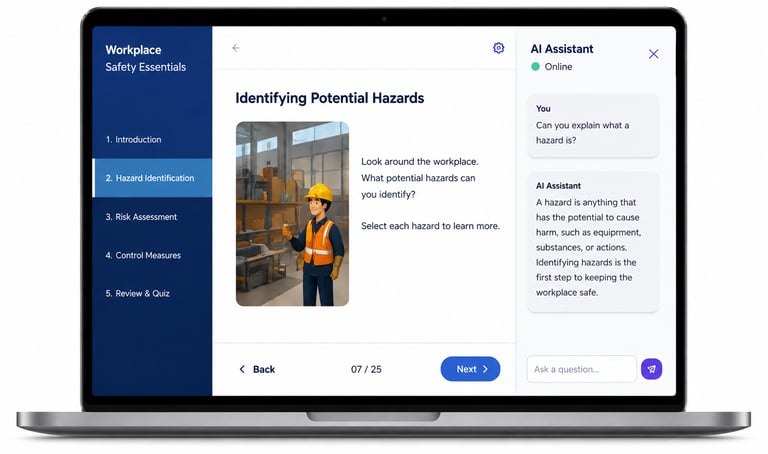


Articulate Storyline


WebGL


Javascript
3D Interaction


Technical Learning
Project Type
Advanced Storyline Interaction
My Role
Tools Used
Focus
Output
Instructional Designer & Storyline Developer
Articulate Storyline, WebGL, JavaScript, HTML, CSS
Real-time 3D object exploration
Interactive 3D course prototype / proof of concept
The Challenge
In many technical and visual learning experiences, learners need to understand an object, part, product, or structure from multiple angles.
Traditional eLearning often handles this by using static images, sliders, or pre-rendered image states. While this can create the illusion of 3D movement, it can also limit learner control and increase development complexity.
Common learner experience issues include:
Viewing an object only from fixed angles
Depending on multiple static image states
Limited control over rotation and exploration
Reduced sense of realism and spatial understanding
Heavier maintenance when image assets need updates
The challenge was to create a smoother and more flexible 3D learning interaction inside Storyline while maintaining usability, performance, and a clean learning experience.
My Analysis
I approached this challenge as a learner experience and interaction design problem, not just as a visual enhancement.
The objective was to replace a simulated 3D experience with a more authentic, real-time 3D interaction that allowed learners to explore an object more freely.
Through analysis, I identified that a WebGL-based interaction could:
Allow real-time object rotation and exploration
Reduce dependency on multiple static images
Create a smoother and more realistic learner experience
Support technical and product-based learning
Simplify long-term updates and maintenance
The key consideration was ensuring the interaction remained instructionally useful, easy to control, and aligned with the learning goal instead of becoming a purely decorative 3D feature.
The solution
I designed and developed a WebGL-based 3D interaction embedded directly inside an Articulate Storyline course.
The solution allowed learners to interact with a 3D object in real time, rotate it, explore its structure, and view it from different angles without relying on predefined image states or slider-based movement.
The interaction was designed to feel smooth, intuitive, and learner-controlled. Instead of passively viewing a sequence of images, learners could actively explore the object in a way that supported spatial understanding and curiosity.
The goal was not to add 3D for visual effect alone. The goal was to create a more realistic, flexible, and scalable interaction that improved how learners explored complex visual content.

How it works: Learner Journey
1
2
3
4
Learner Sees the Object
Interact in 3D
Explore Key Details
Build Understanding
The learner enters the course and sees a complex object that needs to be explored from different angles.
The learner uses the embedded WebGL interaction to rotate, zoom, or inspect the object directly inside the course screen.
The learner views important parts, surfaces, or structures more clearly through real-time interaction.
The learner gains a better sense of the object’s shape, structure, and purpose through active exploration.
Product Training
Technical Training
Equipment Training
Manufacturing Learning
Healthcare Device Training
Where This Can Be Used
Engineering Education
Purposeful 3D in Learning
For technical training, 3D interactions should be used when exploration, spatial understanding, or object familiarity supports the learning goal.
They should not be added only for visual novelty.
In this prototype, WebGL is used to make object exploration smoother, more realistic, and easier to maintain than multiple static image states. The interaction supports learner control, visual understanding, and a more active learning experience.
Conclusion
This project demonstrates how WebGL can be integrated into Articulate Storyline to create a more realistic and exploratory learning interaction.
It highlights the value of combining instructional design, technical development, and user experience thinking to improve how learners engage with complex visual or technical content.
The final prototype shows how advanced web-based interactions can extend Storyline’s capabilities and create learning experiences that are more interactive, scalable, and learner-controlled.