From Click-Through Training to Decision-Based Learning
A before-and-after case study showing how passive click-through training creates cognitive debt — and how decision-led learning helps learners actually apply what they learn.


Articulate Storyline


Javascript


Technical Learning
Project Type
Before & After Learning Design Case Study
My Role
Tools Used
Focus
Output
Instructional Designer & Storyline Developer
Articulate Storyline, JavaScript, xAPI, HTML, CSS
Decision-led learning and behaviour change
Two working course demos showing passive vs. active learning design
The Challenge
Most corporate training looks interactive on the surface.
Learners click cards, reveal definitions, move through screens, answer a recall quiz, and collect a certificate. But clicking is not the same as thinking. When the learner only receives information, the course may prove completion — but it does not prove judgment.
This creates a hidden learning problem: the learner has seen the content, but cannot use it when a real workplace situation appears.
That gap is what I call cognitive debt.
My Analysis
The issue was not the topic, the visuals, or the amount of content.
The issue was who was doing the thinking.
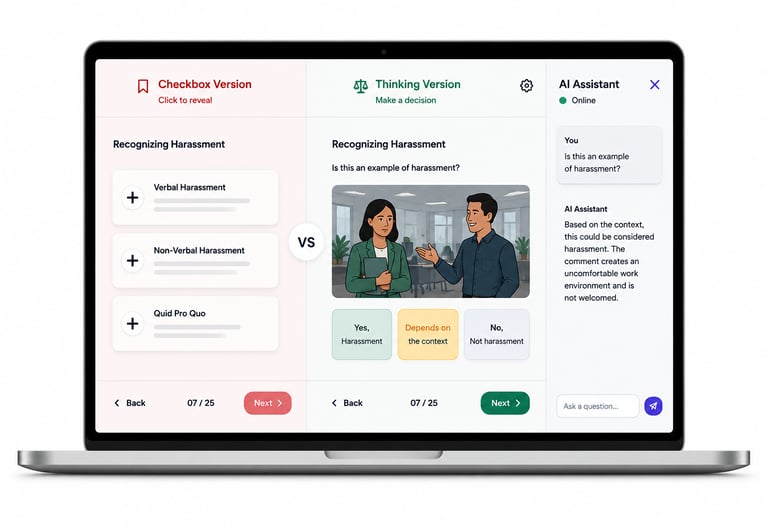
In the passive version, the course gives the answer first. The learner clicks to reveal information and moves forward. It feels smooth, but there is very little mental effort.
In the active version, the learner has to decide first. They judge situations, predict outcomes, respond to scenarios, build processes, and receive consequence-based feedback. This shifts the experience from content exposure to workplace decision-making.
The goal was to redesign the same course so the learner could not pass by blind clicking.
THE EXPERIMENT
Version A: The Checkbox Course
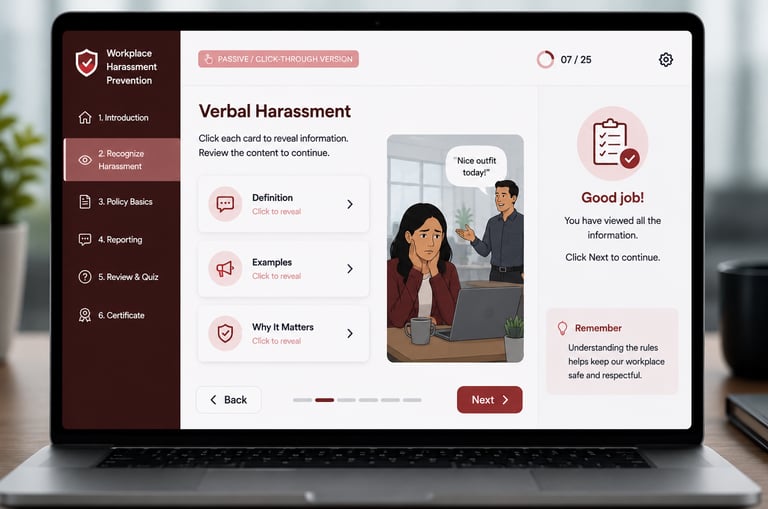
Polished, easy, and completable without a single moment of real thinking.
This version uses passive click-to-reveal interactions, simple recall questions, and certificate completion. It looks interactive, but the learner can move through it without applying judgment.
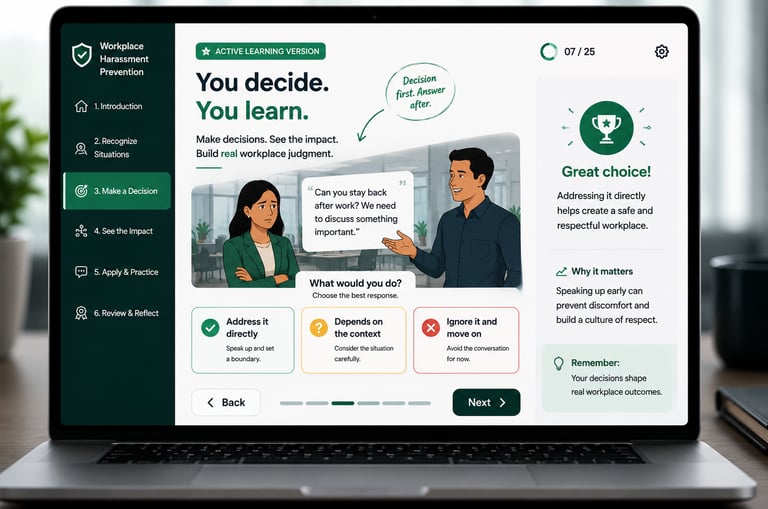
Version B: The Thinking Course
Same topic, same visual direction — but every screen requires the learner to commit to a decision before the answer appears.
This version uses scenario judgment, prediction, ambiguous sorting, multi-turn branching, process sequencing, conversation simulation, confidence rating, and transfer-based assessment.
Before · Passive
After · Active
The solution
I redesigned the course around a simple instructional principle:
Design for the decision, not the slide.
Instead of asking learners to click and receive information, the active version asks learners to make a judgment first. Feedback then explains the consequence of that judgment and connects it back to the workplace rule.
This approach makes the learner practise the behaviour the course is supposed to create.
How it works: Learner Journey
1
2
3
4
Learner sees a realistic workplace situation
Learner makes a decision first
The course shows the consequence
Learner applies judgment again
The course presents a situation that could happen at work, not just a definition or rule.
The learner must choose, sort, predict, respond, or sequence before the answer is revealed.
Feedback explains what the learner’s choice could lead to in a real workplace.
The learner continues practising with new scenarios until they can transfer the rule to unfamiliar situations.
THE CRAFT BEHIND IT
Decision-Gated Progression
The course does not allow learners to move forward just because they clicked something. Progression is linked to meaningful interaction, decision-making, and completion of the intended cognitive task.
Real-Time Readiness Scoring
A scoring system tracks decision quality across the experience, not just whether the learner reached the final slide.
The build can capture what learners actually did — which decisions they made, where they struggled, and whether they improved — instead of only recording completion.
xAPI Behaviour Tracking
Compliance Training
POSH / Harassment Prevention
Code of Conduct
Cybersecurity Awareness
Manager Training
Where This Can Be Used
Onboarding
Purposeful Interactions in Learning
An interaction should not exist only to make a screen feel active.
It should make the learner think, decide, practise, or reflect.
In this case study, the active version replaces passive interaction with decision-first learning. The learner does not just see the policy. They practise applying it.

Conclusion
This project demonstrates how the same course content can create two completely different learning experiences. The passive version proves that a learner completed the course. The active version gives the learner repeated practice in making better workplace decisions. That is the difference between training that looks finished and training that changes behaviour.